

Dear Friend and Reader:
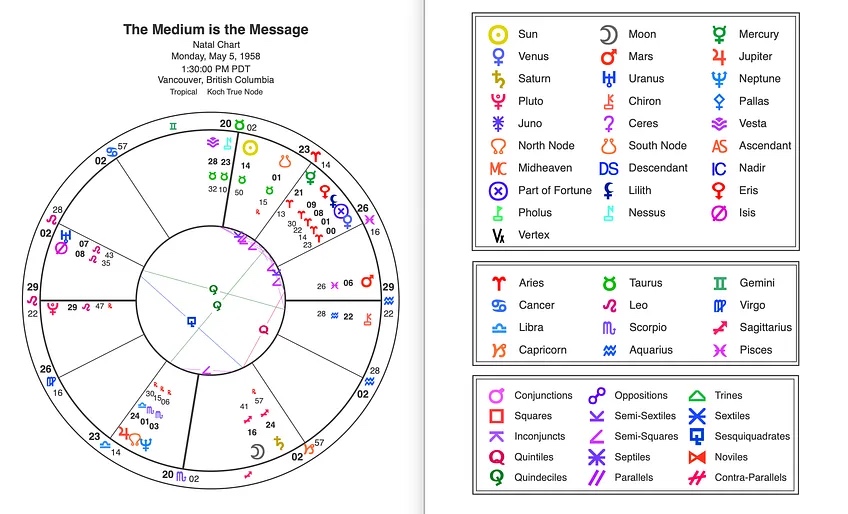
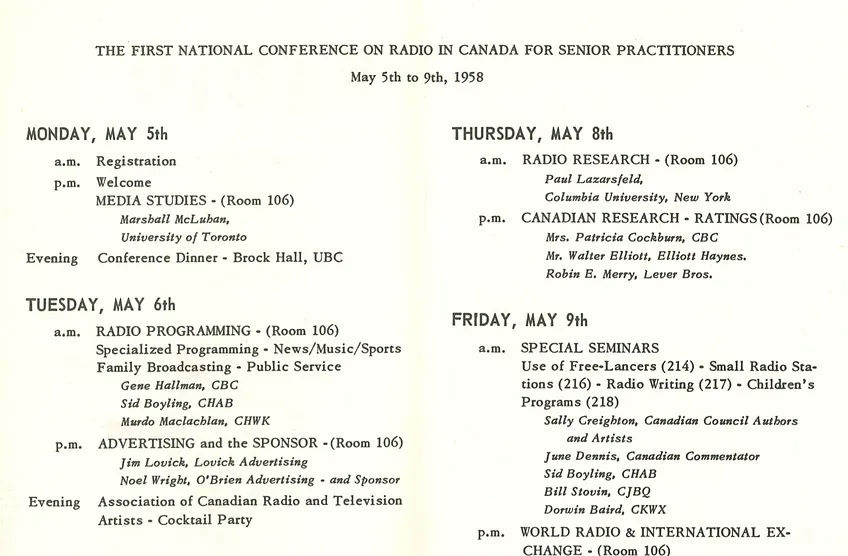
May 5, 2026 marks 68 years since Marshall McLuhan first publicly presented a version of the phrase “the medium is the message.” He did so May 5, 1958 at the “Radio in the Future of Canada” conference at the University of British Columbia (UBC), Vancouver, Canada. Andrew McLuhan asked me if I would do a reading of the astrology chart for this event. Here you have the result.
McLuhan’s presentation to the radio men was a succinct introduction to everything he would say and write for the rest of his life. This includes elaborating the profound effects of print technology and the way that they were unraveled by electrical media. Linear, sensible categorization gave way to the chaos of simultaneous experience that can only be navigated by intuition and pattern recognition. We would do well to remember that today.
His remarks were given in the context of the future of Canada and radio execs who were concerned that television would demolish their industry. In fact, video did not kill the radio star, and radio persisted as a useful and influential form for at least another 40 or more years. Radio remains influential today but has lost ground not to TV but rather digital delivery of audio programming.
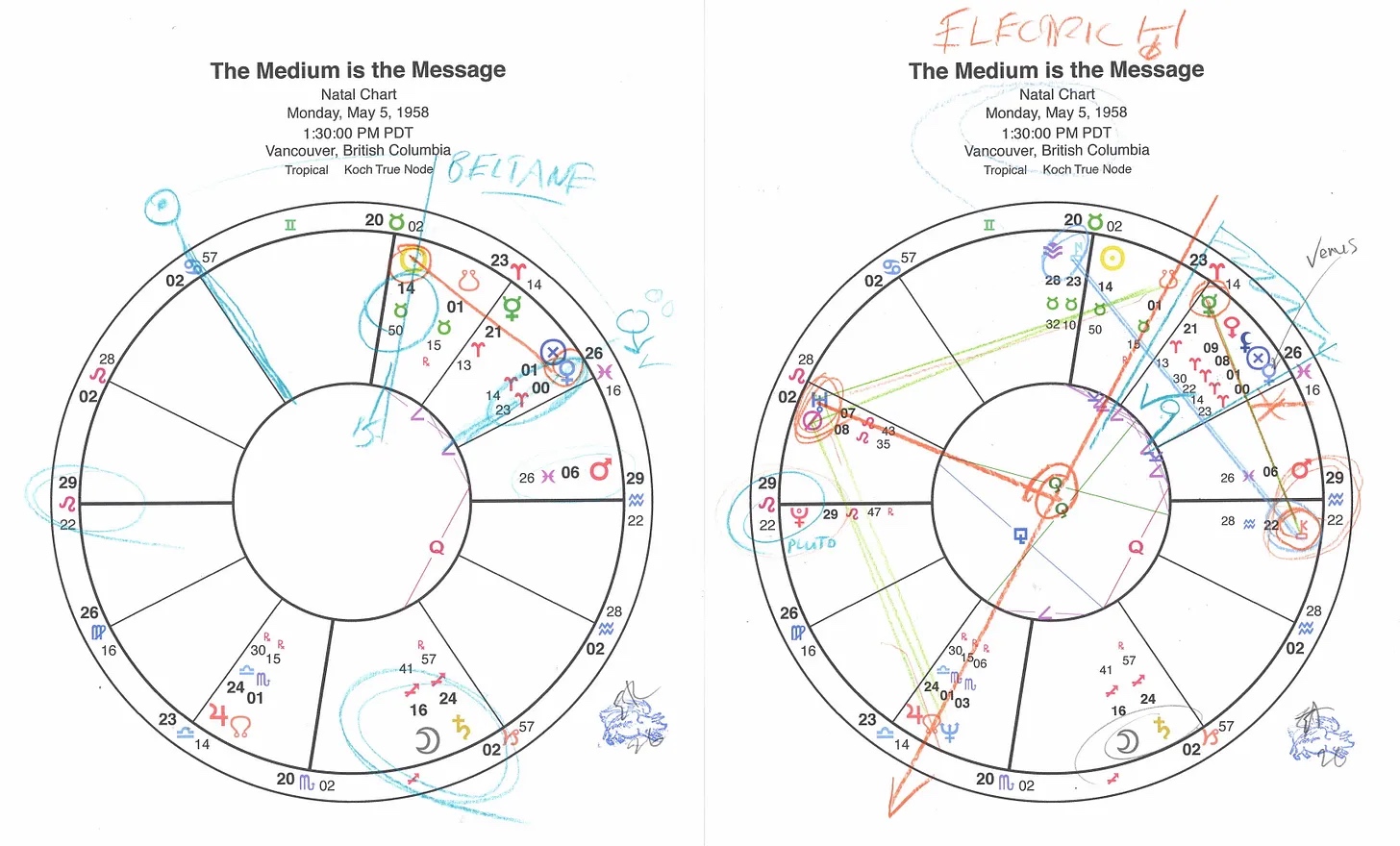
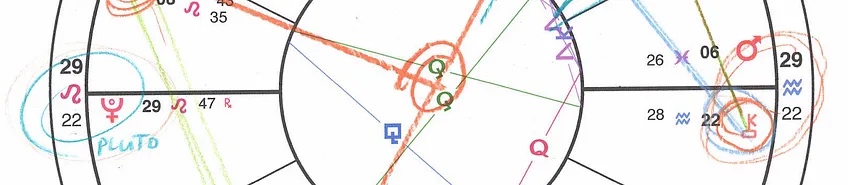
This is what the chart looks like, in two versions, with my annotations — classical to the left (prior to the discovery of Uranus in 1781) and modern:
The Medium of Astrology
Since most people are unfamiliar with astrology, it might be a good idea to explain something about what it is. Astrology includes a language with a syntax structure, but it’s also a system of divination: of seeking meaning from data derived through a random factor like tossing I Ching coins or drawing a tarot card. The main difference is that astrology is an extremely complex form of divination.
The thing being divined off of are the placements of the planets and the mathematical relationships between them. These transpose into a system of references that resemble a language, though technically it probably does not qualify. It is more than a technology with its own jargon. Within astrology itself there is syntactical structure that gets good results much of the time.
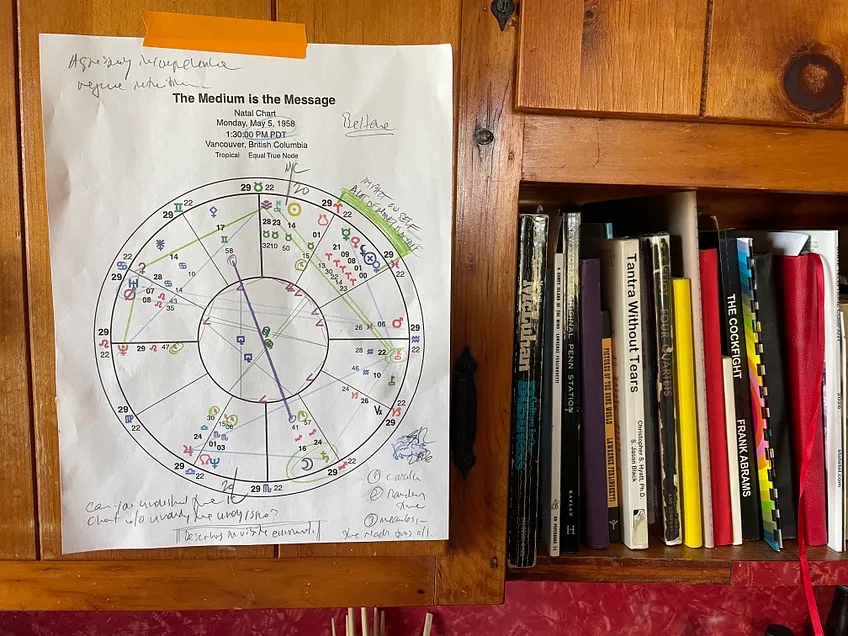
One way that astrology differs from any other commonly known language is that the information is presented in a circle that represents the timing of many natural cycles, with the planets connected to archetypes. Any element around that wheel can relate to any other element in a diversity of ways. Hence, a one-page document can contain as much information as a book.
A Holographic Quality and a Form of Divination
Second, all of that information is retrievable with coordinates on Earth and a specific time (latitude, longitude and time of day). However, because the geographic coordinates are usually for an entire city, anything that happened at that exact time and place (presumably many different things) will have the same chart. So charts are highly context-specific. In astrology as in life, context is meaning.
Last, astrology is a form of divination: seeking meaning from something that seems random or unplanned, such as the time of birth, a team winning the World Series, or an airplane crash. The date and place of McLuhan’s presentation were not chosen by the speaker but fit a wider pattern (a conference).
Charts contain so much information that any reading is partial; and any reading is going to be the subjective view of the astrologer. There are rules of interpretation but they leave a lot of wiggle room. More or fewer factors can be added to any chart, so there are many variables.
Timing the Chart
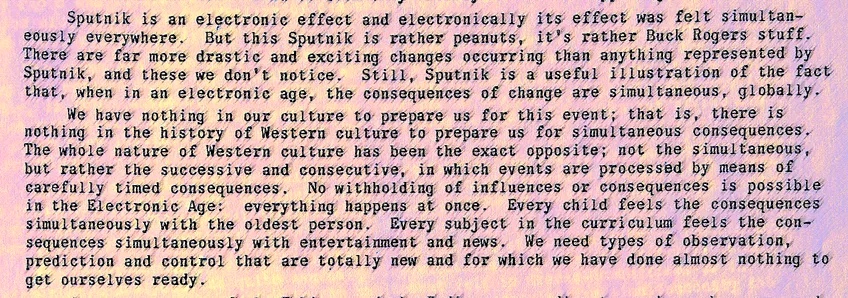
Astrology is a celestial clock that must be synchronized to ordinary time. The correct timing of charts is therefore very important in astrology.
The degree rising (in the east) moves at the rate of one degree approximately every four minutes. We know the day McLuhan gave his talk, but the exact time is unrecoverable. However, we know that his presentation was the first item in the afternoon session, which presumes after lunch. The time was not written down and nobody who was there is available to query (nor is it likely that they would have looked at their watch and jotted down the time).
There are several ways to handle this using astrological tradecraft. One way is to do a formal rectification or reverse engineering of the time. This is extremely labor intensive and subject to error. Another way is to work out the most probable time given the available facts, take a guess, cast the chart, and see if it speaks. I worked out 1:30 pm as a potential time, cast the chart and it jumped to life.
The process of reading the chart is also that of testing the chart. Astrology is a probe, which leads to dialog and other experiences. One fun way to proceed collectively would be to create a basic timeline of important events in the history of the idea and chart it in planetary movement. If someone wants to help with that, I am game.
First Pass Chart Interpretation
The chart for a philosophical concept can take years and much investigation to understand. What I am offering in this article, in this section and below, is an opening gambit or a first pass through the territory. I’m going to stick to a few concepts.
All astrological interpretations are the view of the astrologer. While they may be supported by astrological ‘arguments’ that pertain to classical principles, there is a problem in that so few people (including other astrologers) understand astrological principles that astrologers can say anything they want. Here goes.
“The medium is the message” is an idea with gravitas and profound evolutionary impact, but it will be felt in subversive ways (Pluto moving in retrograde motion exactly rising in the last degree of Leo). The idea will expose much that has previously been concealed from view — though available, it went unnoticed as if hidden in a dresser drawer.
It will be an enduring concept, as it was introduced at the Sun’s movement through the midpoint of the fixed sign Taurus (at the Beltane cross-quarter, or midway point between spring and summer), which is amplified by contact with 12 different mathematical points in the wheel. Though it may not be noticed, the idea has far reaching effects for every facet of life.
Between Two Major Astrological Eras — Pluto in Leo and Virgo
The passage of Pluto through the signs or divisions of the astrological wheel stands for major eras, both historically and in the life of a person.
The concept of “medium as message” or “medium as idea” was born at the turning of the ages — weeks before the astrological 1960s begins (which happens in June 1958, when Pluto enters Virgo).
A certain kind of spiritual destabilization and chaos (the Uranus square Neptune era, which dominated the 1950s, with its A-bombs, H-bombs, red scares, pink scares and better living through chemistry) is at this time leading into a more mentally grounded intellectual investigation but also profound upheaval (Uranus conjunct Pluto in Virgo, the astrology at the heart of the Sixties).
The investigation implied is in one sense about the effect of media environments on society. Yet the most significant dimension is about the influence of technology on self and self-concept. This connects to the corresponding spiritual crisis instigated by changes in the technology environment (Mercury, Venus and Eris in Aries in the 9th place). An essential dialog is necessary between individual influences and events (Mercury in Aries) and collective events (Chiron in Aquarius). This message is repeated in this chart at least three times.
Brilliant Idea with Limited Capacity for Acceptance
“The medium is the message” functions as a tool to probe the environment at the same time it serves as an agent of change. There are settings where that change will go off like a pipe bomb (Uranus in Leo conjunct Transpluto in Leo). Uranus is an agent of progress, invention, revolution and technology.
Discovered in 1781 — the first planet discovered by science — Uranus was the harbinger of the electrical age. Transpluto, a hypothetical, nonphysical planet, represents an intellectual limitation or constraint. It is specific and classified while Uranus breaks boundaries and is experienced in a simultaneous way. We have seen this clash with McLuhan’s work over and over again.
There are other places where the idea of medium as message will seep in through the spaces and cracks in existence like a mystical experience, or with more of a gaseous effect (Neptune retrograde in Scorpio on the North Node). Others will find it seductive and irresistible (an effect of Scorpio).
And there will be people who actively resist, which we know historically. Transpluto is a rarely-used hypothetical planet; it is a kind of mathematically justified artifice orbiting the Sun in about 685 years. For many people, it is a real irritant, eroding their self-confidence and self-esteem.
Looking Backwards Through Binoculars
Its quality is like looking at something through the wrong end of binoculars. Imagine bird watching that way; you would never know what you’re looking at. The Uranus-Transpluto conjunction points to the main problem that the concept will encounter: that of closed-mindedness, limited thinking and lack of curiosity (all described by Transpluto).
So we have the clash of a brilliant invention that lands in a space of limited mental capacity. We see this parodied in Marshall McLuhan’s cameo appearance in the Woody Allen film Annie Hall, where the gasbag rambling Ivy League professor of media knows absolutely nothing about McLuhan’s theories upon which he is expounding. McLuhan ad-libs: “You mean my whole fallacy is wrong.”
Others show up with the brilliant argument, “I don’t understand that so it can’t possibly be true.” It is better to change the topic to fried chicken or the New York Mets. I will close this article with a final comment about the Uranus-Transpluto conjunction.
What Does The Medium is the Message Mean?
Part of why this concept is so elusive is that the words ‘medium’ and ‘message’ have multiple inflections, though ‘is the’ makes it seem like you should know exactly what’s going on. In his initial presentation, McLuhan also says, “The medium is the meaning.” This seems much easier to grasp. It is first introduced as “The media are the messages.” But let’s stick to the known form: “The medium is the message.”
First inflection: The ‘medium’ is the total environment of a technology, which usually exists below the level of immediate perception.
The environment usually goes unnoticed; it is subliminal. the ‘message’ are the effects of that environment. Typically, only the content is noticed or critiqued. In this sense, the ‘message’ would be the transformational force of the technology environment itself rather than any specific content or programming.
Twitter changed the world; no tweet did so. Television changed the world; no TV show changed the world to any comparable degree. An innovative TV program may change TV programming, but not existence.
Content is relevant on another level, and this issue is often left unfocused. Whatever television did to us as individuals and society, you can still learn things from TV, or have a good time watching the game. But that does not speak to the underlying transformational power of the television environment. And a football game watched on TV is not the same game witnessed in person. For one thing, there are not 75,000 people in your living room. All in the Family is still a fantastic TV show, but it changed television far more than it changed society. In a sense, the content and theme of the show was provoked by the effects of television itself.
Almost always, transformations of individuals and society by a new technological environment take forms that could never have been predicted. Any newly introduced media environment is an uncontrolled experiment on existence.
Second: The medium through which material is delivered will bias and shape one’s experience of its subject matter; the effect and therefore the message is different.
The same presentation of facts and viewpoint differs if delivered in print, audio or video (or other) formats. The same argument that succeeds brilliantly in radio format can fail miserably in a video environment.
The delivery medium biases the experience of the subject matter. The same family news is different when delivered on the phone, in person, or by letter. Some topics come across more effectively with moving images and others succeed with voice only. The same story told by a book is entirely different when it is told in a movie, in both form and content. Many movies miss the point of the book or cannot get it across. In this sense, the delivery medium becomes the message.
Content producers can take notice of this and learn how to deliver their ideas in a style conducive to that medium. The people who can do this intuitively are often the most successful and persuasive. This is most of what artists do.
In this second sense, the ideology that might dominate a place and time is often the product of the contemporaneous media environment rather than the driving force. Most people would point to the ideology as the agent of change when really it is coming along for the ride like the foam at the crests of waves. The waves are the product of tidal forces. The foam is decorative.
Third: For the best information, study the background with more emphasis than the figure. Medium/message = ground/figure contrast.
This implies (for example) studying the internet environment as more relevant than any content; and studying trends in content is useful because it provides evidence of what is happening in the environment. Study the audience and not just the show.
To me, ‘the medium is the message’ is a reminder to pay attention to what I call the ‘ground field’, that which is happening in the background, not being noticed, out of sensory perception.
To give an easy example, I usually learn more from reading the comments on an article in The New York Times than I do from the article itself. The fact of having comments added in real-time demonstrates that the print edition and the online edition are two totally different things.
The Unsealed Letter: A Closer Look at the Chart
Let’s look at some of the nuances in the chart. The first thing most astrologers’ eyes would go to is that the last degree of Leo is rising, and that the meaningful planet Pluto (then only three decades since discovery and largely unused by nearly all astrologers) is occupying the degree rising. Nobody would have seen this at the time.
Pluto is retrograde. There is your sublime but veiled impact. Retrograde actions often conceal their full effects.
There are several systems of degree-by-degree symbols in astrology, where each degree gets a concept or image. The last degree of Leo is somewhat famous, and its degree symbol is “An Unsealed Letter.” The theme of the degree is that everything previously hidden will some day be known. Here is what Dane Rudhyar had to say about that degree:
The fact that a letter is unsealed does not imply a trust that other people will not read its contents, but rather the idea that the contents are for all men to read. The letter contains a public message in the sense that when man has reached the stage of true mental repolarization and development — which we see in the very first symbol for Leo — he has actually become a participant in the One Mind of humanity. Nothing can really be hidden, except superficially and for a brief time. What any man thinks and deeply ‘realizes’ becomes the property of all men. Nothing is more senseless than possessiveness in the realm of ideas. If God speaks to a man, Man hears the word. Nothing can remain permanently “sealed.”
That offers a rather stunning and hilarious image of the way that privacy is eliminated under electrical conditions, going right back to telegraph and telephone, through radio and into the current digital age.
Jean Shepherd’s Comment About Radio as a Medium
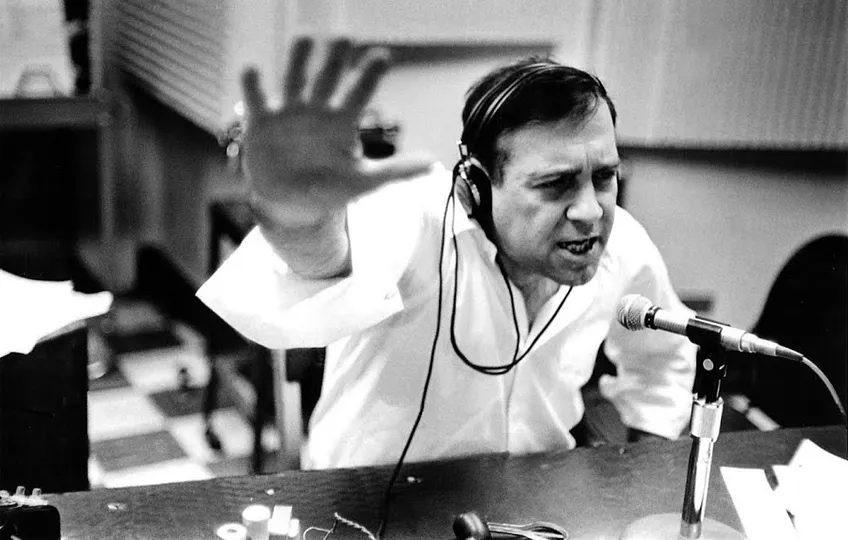
Remember that this is the chart for the presentation to people in the radio industry. Jean Shepherd, the renowned nighttime recontour on WOR-New York Radio from 1955-1977, is one of a very few people mentioned by name in McLuhan’s 1964 book Understanding Media. McLuhan said that Shepherd spun a kind of oral novel every night on his 45-minute program.
I heard one broadcast where Shep commented that with radio, people think you’re talking directly to them — but this never happens when you’re on television. Nobody takes TV personally; but they take radio personally. We see this in the chart with Venus on what I call the Radio Point.
Venus On the Radio Point (or Aries Point)
Venus is in the first degree of the zodiac, which gives it prominence and speaks to the enduring power and popularity of radio.
The first degree of Aries (which is the first degree of the tropical zodiac) is formally called the Aries Point. It represents the reckoning between the horoscope based on the seasons (the one used by Western astrologers) and the Sidereal horoscope based on the stars used in India (the East). It is, in a sense, the East meets West point.
It was first delineated and brought to popularity as an astrological tool in the 1920s by the Hamburg School or Witte School of astrology (this is today known as Uranian astrology and sometimes as Cosmobiology; it is a boutique item but highly informative).
A Public-Private Intersection
The Aries Point is a private-public intersection. It extends identity and the senses into the collective realm and brings public events right to people — “the world crashes into my living room,” as David Byrne put it in the 1985 song “Television Man.”
This degree was extremely active early in the commercial radio era when it was delineated by Alfred Witte, though the planet that was there had not been discovered: that was Eris, which was in the process of entering Aries (passing back and forth over the Aries Point). It’s discovery would not happen until 2005, early in the era of what I call “full digital conditions.”
And fast-moving Venus is sitting right in that degree for the opening of the conference and at the time McLuhan gave his presentation. This talks about the way that a medium affects people not just as individuals but at the intersection of where the individual meets the collective. The Part of Fortune is right there in the next degree. As Jean Shepherd, Rush Limbaugh, Howard Stern and many others demonstrated, radio would be a very successful business going forward.
The Part of Fortune by the way is more than a point in the chart. It becomes the false ascendant of a derivative “chart of fortune,” which — appropriately — begins in Aries.
Other Points in Aries
There is a cluster in Aries in this chart, demonstrating the personal nature of radio’s impact and of new communications technologies generally. As mentioned, this includes Aries, the Part of Fortune, Eris and Mercury. These are in the 9th place, which is about spiritual matters. The chart presents the illusion that they are in the transactional 8th place (no doubt on the minds of the attenders) but the real matter is the human impact. In my view, the spiritual crisis precipitated by electrical and electronic media is one of the most important of our lifetimes.
Mercury Connects to Chiron
Chiron was discovered in 1977, six months before Jean Shepherd left nightly radio. It is a middle solar system object, usually outside the orbit of Saturn. It is a point of focus, transformation and the concentration of awareness. In this chart, it’s toward the end of its long journey through collective Aquarius, about to enter Pisces in March 1960 (another harbinger of nascent Sixties consciousness). Mercury (mind, communications) is in a close dialog with Chiron, bringing the collective to the individual and back again — a specialty of radio.
The Moment Before the Sixties Begin: Pluto About to Enter Virgo
McLuhan was the man of the hour in the 1960s, one of the outstanding cultural luminaries in a time when there were many others. I am always chuffed that this feat was pulled off by a professor of English whose day-job was teaching Shakespeare, Eliot and Joyce.
The movement of Pluto describes long historical eras. In this chart we see Pluto in the last degree of Leo, about to enter Virgo. Pluto had been in Leo since 1937, at the height of the Great Depression and before U.S. involvement in World War II. Pluto in Leo takes us through the (American) prewar era, the war itself, then into the influx of G.I.s back into the country and the building of contemporary Western culture.
It covers the impact of the Beat Generation of writers (Howl by Alan Ginsberg was published in 1956), the Hula Hoop, as well as the early rock and roll era. The Fender Telecaster (the first production electric guitar) comes out in 1951, with a reference to television in its name. When someone says “Baby Boomers,” they are describing people born with Pluto in Leo.
McLuhan’s presentation occurs weeks before Pluto in Leo becomes Pluto in Virgo and we enter the proto-1960s. He was heralding this era with his unsealed letter.
Jupiter is in the 3rd House
The 3rd house is local. At its best, radio is a local medium, not a national or international one. True, clear channel stations on the other side of the Rio Grande could reach most of the United States at night by skip signal and this had a profound effect on society. Grand Ole Oprey influenced generations of nascent musicians from great distances across the plains and prairies.
Radio had and to some extent still has a way of dissolving international borders by broadcasting across them (think: Radio Free Europe, beamed out in 24 languages to 18 countries across Europe, Asia and West Asia). Still, it’s beneficial to think of radio as local media — and most stations pretend that is what they are.
All radio stations localize their presentation to make themselves seem like they are located down the street.
The Illumination of Genius Meets Half of the Brain
Let’s come back to this because it is in a sense the Achilles heel and power center of the chart. I’ve described this twice — Uranus conjunct Transpluto. To many, McLuhan’s ideas seemed a little oblique, but only if you’re trying to reason them out strictly with your rational mind. They require the whole brain collaborating with itself — and train that ability through use and application.
Once you bring creativity and intuition to the mix (i.e., show up with your whole brain instead of half of it), they make much more sense — especially when you see them play out in the world and in people’s lives. So as with many things, the proof of the theory is not the theory itself but how it works in reality (and this is much more fun).
And once you see the transformational power of the environment, and feel it, you cannot unsee it. To understand that the environment is what communicates and transforms us comes with a shift in worldview and even cosmology.
Ultimately, media studies (like astrology) is a study in life. Proof of its validity is evident only to those who apply their curiosity and experience it directly. It must also be experienced with a sense of adventure — and leaving old models of strict categorization and linear thought behind. It helps to lose your mind an come to your senses, at least temporarily.
Perhaps the fallacy of “the medium is the message” is that it’s presented as a logical syllogism when really it is no such thing. It would be more accurate to say, “We are all part of the world we live in. The world affects us, and we affect it.”
Mitákuye Oyás’iŋ —