


Today’s Aquarius Full Moon takes place on the anniversary of the grand cross, total solar eclipse in Leo of Aug. 11, 1999. This event, anticipated for many years prior, was the harbinger of the millennium to come.
Painting by Lanvi Nguyen.
Read later: Introduction to Trust by Eric Francis on Medium.com
Painting by Lanvi Nguyen.
The Plutonium Thing
The 8/11 controversy involved Cassini packing 72 pounds of plutonium-238, used in its RTG battery — a radioisotope thermoelectric generator. In an RTG, the plutonium gives off heat as it decays, which is transformed into electricity to power the ship’s systems and its various experiments. RTGs have been used throughout the space program, particularly in situations where solar power was deemed impractical, or more energy was needed. (The RTG aboard Apollo 13 was reportedly dumped from the disabled spacecraft prior to its reentry in order to protect the environment in case of burn-up on reentry, a fact that was left out of the movie.) Cassini carried enough plutonium to give every person on Earth cancer many times over. Had the ship entered the Earth’s atmosphere during the slingshot, it would have burned up, disintegrated and eventually spread radioactive dust onto every continent. Days before the maneuver, NASA relented and increased the altitude from the originally-planned 450 miles to about 700 miles — thanks to the efforts of one person, Prof. Karl Grossman of the State University of New York at Westbury. The ship and the Earth survived the maneuver, and we eventually got some great photos of Saturn. But the Cassini flyby of Aug. 11, 1999 stands as a monument to the degree that technologists will take any risk, no matter how it might threaten life on Earth, for the sake of, well, whatever. Nobody got to vote on this. No civilian was asked if they wanted to take the risk. Yet Prof. Grossman, whom I am privileged to know and learn from personally, waged a successful one-man campaign to save the Earth in a time when such was possible. And he got a result. That 350 miles extra altitude for a ship traveling at 42,000 miles-per-hour may have been all the difference in the world. Before there was 9/11, there was 8/11. The grand cross, total solar eclipse was a harbinger of darker things to come, just two years later, at the Saturn-Pluto opposition in the summer of 2001.Full Moon and a Grand Cross
Like the 1999 event, Thursday night’s Full Moon is also a grand cross in the fixed signs Taurus, Leo, Scorpio and Aquarius. (Those are the same signs as are on the tarot card The World, and also referenced in the Book of Revelation.) The Full Moon is not conjunct the lunar nodes (that would be an eclipse). But it is at 90-degrees to the nodes, which is an honorary eclipse and an official turning point in whatever story you’re tracking, writing or living through.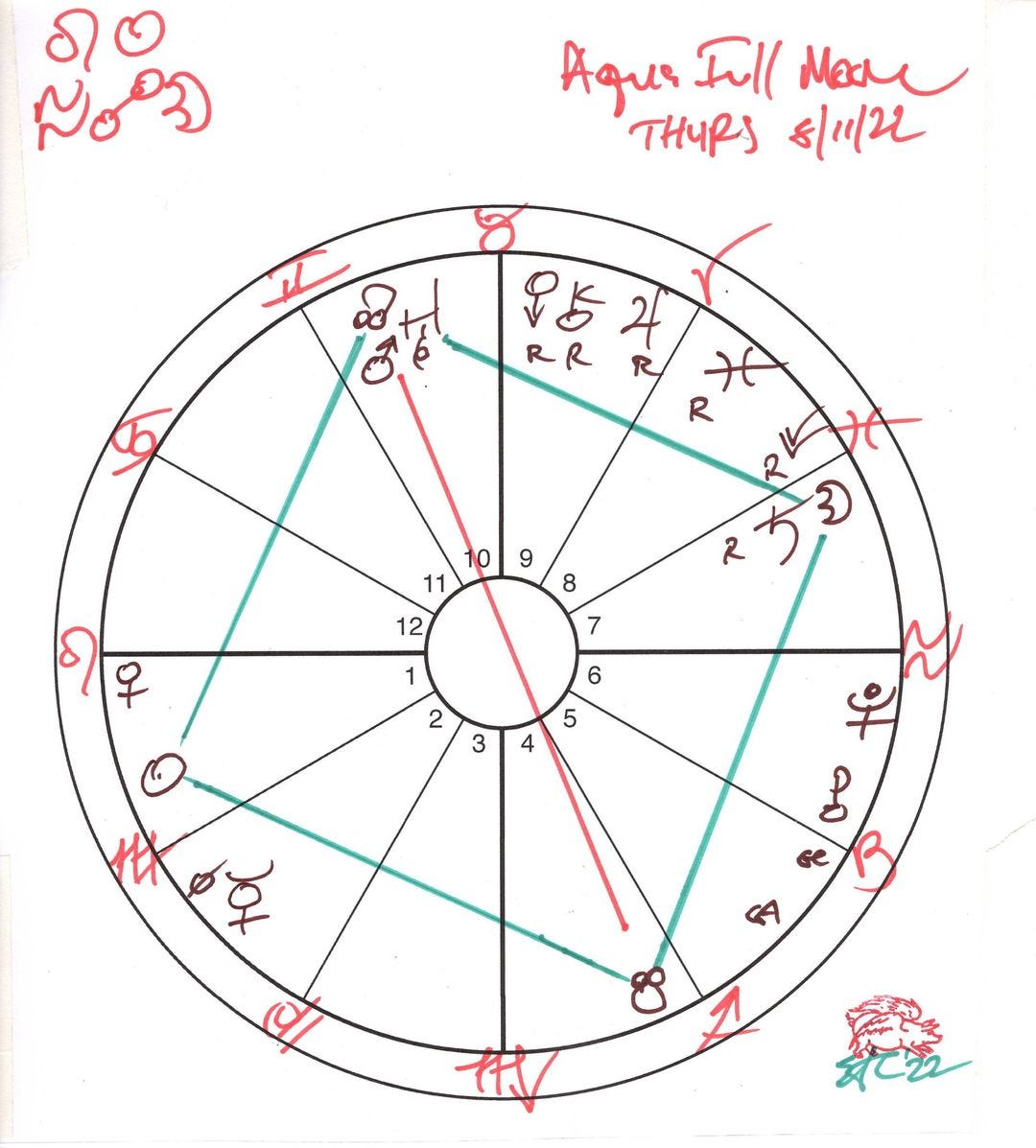
My chart for the Aquarius Full Moon.
Read later: Introduction to Trust by Eric Francis on Medium.com
Painting by Lanvi Nguyen.
Now When We Need it the Most
We are now in a situation where we need trust more than ever. Society has never been so fragile as it is now. We are still finding our way through the wreckage of what was done to us in 2020. I’m surprised people think that all that wreaking of havoc had something to do with a health scare. I’m surprised anyone believed that excluding your children or your parents from the dinner table would save your life, or that it would be worth it. However, I am one of those people who does not think that (most) people are total fucking idiots no matter how much they run that schtick. My sense is that once people slow down, pause emoting and engage their mind, they can get a grip on realty. Or perhaps: once there is no longer a value in feigning ignorance. There is overwhelming social pressure to “do what everyone else does” and show the world what a fool you are. This is wholly deceptive. Most people do this in order to blend in with the tribe. If you’re too smart, if you’ve got your own views, if you assert your independence, I guess the current thinking is you won’t have any friends or be able to get a date. Most of us are accustomed to living in a world where hardly anyone says what they really think; and where anyone who does subjects themselves to punishment. What a cynical and self-defeating prison-mentality this is. Participating in this, we turn ourselves into divide-and-conquer cannon fodder. The Trust Paradox
Here is the Trust Paradox: in order to trust anyone or anything, you must trust yourself first. If you do not, you will have no basis by which to evaluate your own assessment, and therefore to make decisions. In our time, the most violent assault is on people’s relationships within themselves, which starts by fracturing our inner trust and sense of truth. Once that’s happened, people are more likely to project their evaluation outward and seek the approval of authority figures and the mob.
The essence of the result is, what seems terrifying is what seems true. This translates further into, “I won’t believe anything that does not frighten me.” You would probably agree that this has a way of narrowing the possibilities — and begging authority figures to rule by inflicting fear.
By refusing to trust ourselves and one another, we are begging for terrorism from people in authority. We set ourselves up for authoritarian rule. I ask: is that what you want? I mean it. Do you actually want that?
Painting by Lanvi Nguyen.
The Challenge of Trust is Vulnerability
The underlying challenge of cultivating trust is the willingness to be vulnerable. Here in life under full digital conditions, this is usually considered a very bad thing. It’s also unfamiliar for many, potentially even an experience they have never had. (In therapy this is called a “missing experience,” and they are important to note.) Vulnerability and therefore trust can also be something someone has given up on consciously, feeling they’ve been hurt too many times so they’re not going to allow that to happen again. Consider whether you think this is a good example for the people around you. As you do, so you teach. Living on the internet allows for a degree of interchange seemingly without exposure. One can be entirely inconsiderate, and it’s allegedly fine, and nobody can do anything to you but write in all caps. One can merely disappear into the mists. In digital life, being an anonymous sniper is normal. In physical, civic life, it is antisocial at best and at worst, it’s a crime. So we live under a wholly different ethos online, and that has been spilling into real time and real space in a thorough and inescapable way. The mistrust in the present world is not the kind that existed in previous eras — such as back when people had bodies. Back when people could respond to sensory experiences. Back when they wanted to be together — especially in groups. This was previously one of the most indelible facts of human experience: that we want to be together, and experience the strength of our communal existence. And that is what is now under full assault. While our Earth is a beautiful planet, it’s also one where it would be extremely difficult to survive alone. Forget roaming around foraging for food without a little band of neighbors. It’s a tough place for individuals to survive without a support network even at the height of civilization. The digital world gives the false impression that “every man for himself” is actually a viable life strategy. We need one another. All of us here. You can start the reconciliation process by assuming any plea for assistance that you hear to be personally directed at you. Then do what you can. Then see how you feel. That is Dharma. That is acting as if to hold the world together. Faithfully,
Read later: Introduction to Trust by Eric Francis on Medium.com
Painting by Lanvi Nguyen.