


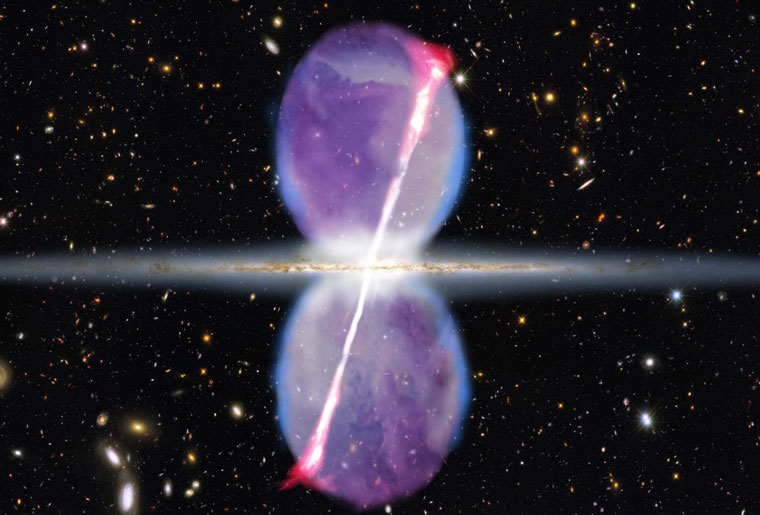
Artist’s conception of our galaxy (the horizontal line) shown with gamma ray bubbles (called Fermi bubbles) discovered in 2010 and gamma ray jets discovered in 2012. The jets and bubbles extend about 27,000 light years above and below the galactic plane, further than the Earth is from the galactic core. There is a lot we don’t know about our galaxy. But these gamma rays are believed to be emanating from the supermassive black hole at the center of the Milky Way. Image by David A. Aguilar. Read more here.
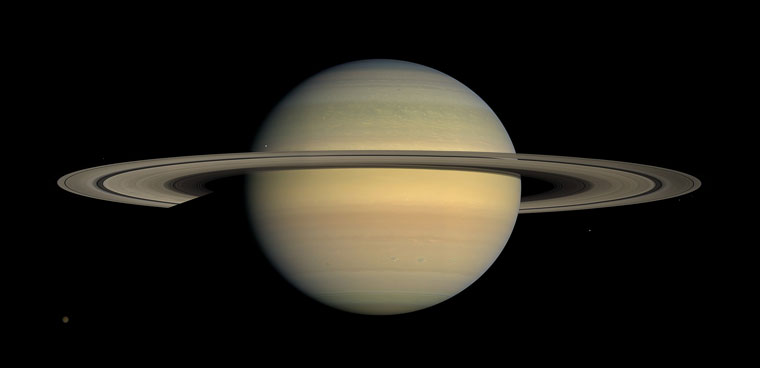
Saturn as seen from Cassini Space Probe
Saturn Square Uranus: Last Quarter Phase
We are all living with a version of this now, in the form of Saturn square Uranus, in effect all year. The square is like the last quarter Moon of the Saturn-Uranus cycle, where the conjunction was the New Moon.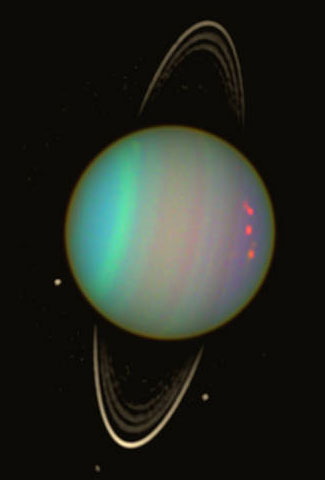
Uranus is tilted; its rings are not aligned with the plane of the solar system. Nobody knows why, or how it got so far from the Sun. Both Uranus and Neptune should be a lot closer than they are.
Reintroducing the Galactic Core
The Saturn-Uranus conjunction of 1988 was close to the Galactic Core in late Sagittarius. Our big spiral island in space has a focal point at its center, and that’s located at about 27 degrees in the same sign where those two big planets met up.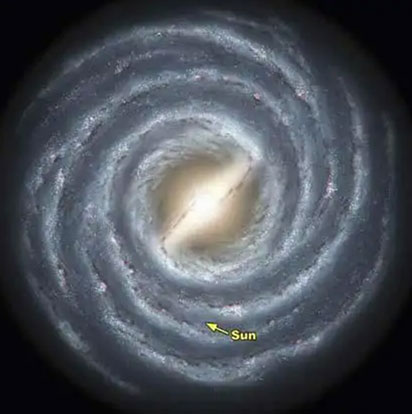
Artist’s concept of a barred spiral galaxy based on what is known about the Milky Way. You can see the Sun’s position shown in the lower part of the illustration — far from the core, and between two spiral arms. In other words, we are in the boonies.
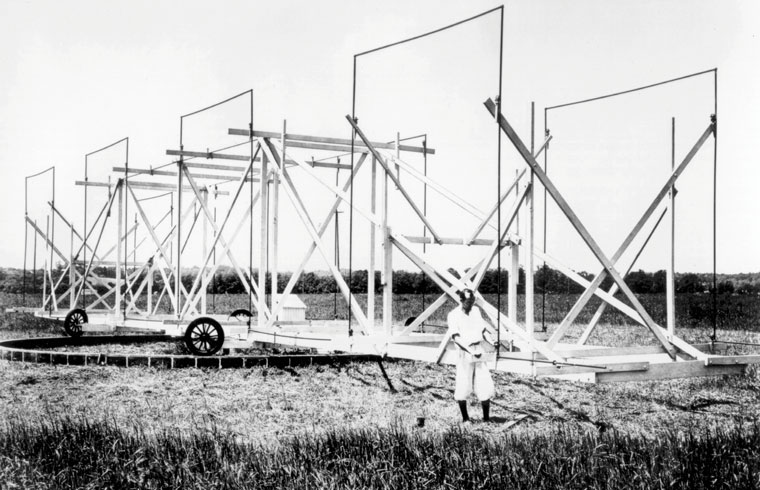
Karl Guthe Jansky is known as the father of radio astronomy, because in 1933 he discovered that the center of our Milky Way Galaxy emits radio waves. He was not an astronomer, however. He was a young engineer with Bell Laboratories tasked with identifying sources of static for their overseas radio communications. He built this rotating antenna to get all-sky coverage at their chosen frequency of 20.5 MHz (wavelength about 14.5 meters), and it quickly got the nickname of “Jansky’s Merry-go-round.” With it, he picked up thunderstorms and a strange hiss that moved throughout the day. He eventually figured out that it was coming from the direction of Sagittarius, behind which lies the heart of our Galaxy.
Of the Distant and the Exotic
It takes place in Sagittarius, the sign of things distant and exotic, with a theme of international communication. One day some Bell engineers were laying telephone cable under the ocean (a perfectly Sagittarian activity), when they noticed interference on the line. They knew it was not some previously identified kind of cosmic ray. Rather, Jansky figured out and later proved that the hissing sound he was hearing was a signal from the center of the galaxy, which had not been previously observed. The emergence of a deep-space point is another fitting symbol of Sagittarius, where it is located. Talk about exotic and distant — and spiritually relevant. Meanwhile, it’s a long way from the Earth to the core — about 25,000 light years. We are located in a kind of backwater area of the Milky Way, and it feels like it. Perhaps the most relevant message of the Galactic Core is how we tend to not be able to feel, or relate to, what it represents. Our galaxy, in turn, is part of a much larger structure called Laniakea, or great heaven, a living system of about 100,000 galaxies all being drawn to a point far deeper into Sagittarius than the Galactic Core. This is called the Great Attractor, the focal point of Laniakea. We are on the tail end of this arrangement, fluttering away with our backs to deep space. If we want community, contact and meaning, we must look to Sagittarius. In the other direction, the next gas station is in Pisces-Perseus, an even more massive group of galaxies located 250 million light years away. And how will knowing this help you get a date on Saturday night? It depends who you’re asking out.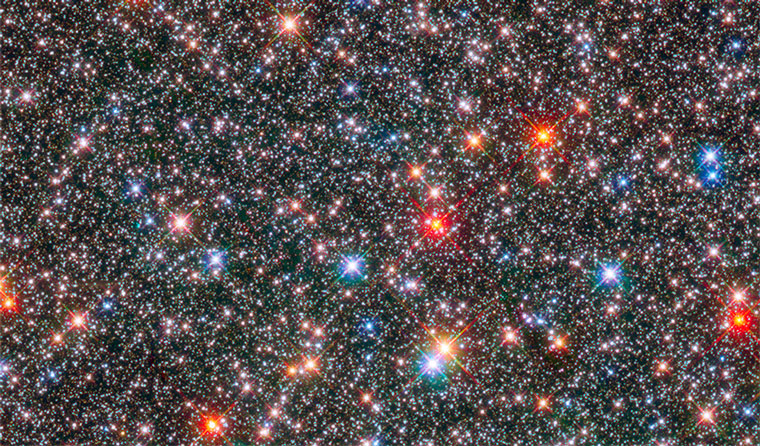
These colorful stars, seen in a 2012 Hubble Space Telescope photo, reside at the heart of our Milky Way galaxy, about 26,000 light-years from Earth. Aging red-giant stars coexist with their more plentiful younger cousins, the smaller, white, Sun-like stars, in this crowded region of our galaxy’s central hub. More info here.
Back to Our Story: What Neptune is Up To
As I said earlier, the most recent Saturn-Uranus conjunction in 1988 was very close to the Galactic Core. Neptune is now making a square to that conjunction, and it’s also making a square to the Galactic Core. Neptune and the core have a similar elusive feeling. Both are famous for insights that are easy to forget. I figured out the Galactic Core and then forgot my delineation so many times that I wrote that into the delineation. Neptune is similar. You cannot really hold into it; consider the dream catcher. Devoted artists and writers have a notebook and pencil with them all the time.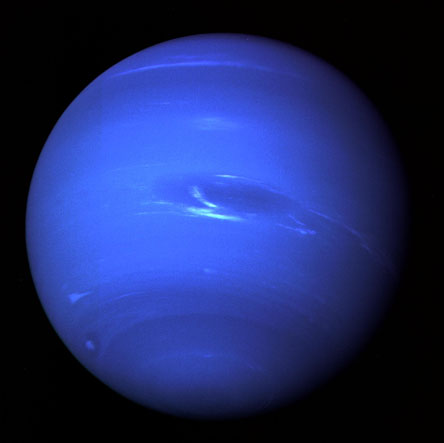
This picture of Neptune was produced from the last whole planet images taken through the green and orange filters on the Voyager 2 narrow angle camera. The images were taken at a range of 4.4 million miles from the planet, 4 days and 20 hours before closest approach.
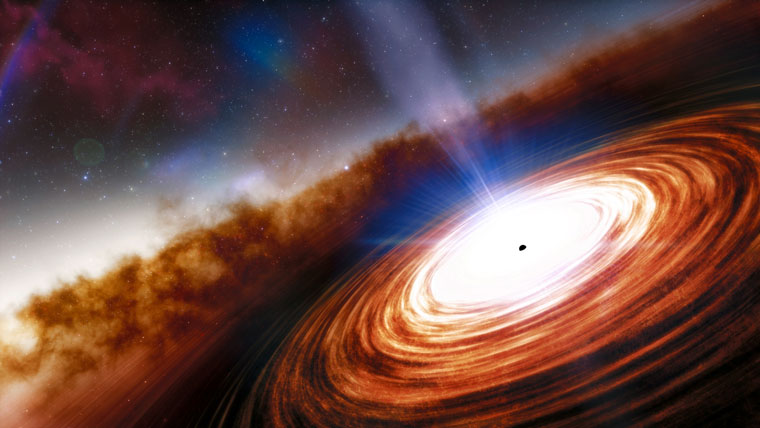
A quasar is a supermassive black hole in the core of a galaxy, wrapped in a bright disk of material. The most distant quasar now known is J0313-1806 (illustrated), which dates back to when the universe was a mere 670 million years old. This is an artist’s illustration. More info here.
At the Core: A Supermassive Black Hole (and a Lot of Chaos)
At the core of our galaxy, according to the last few hundred discussions by astronomers that I’ve heard or read, is a supermassive black hole. If the Galactic Core serves as a spiritual homing signal, at the heart of the matter is a deep, dark mystery. You might call it the mystery of death, or of the origin of consciousness. Whatever is there, it’s a reminder of the great unknown, which is so often avoided. It’s also an unavoidable force, which nearly everyone tries to avoid. From listening to many astronomers and astrophysicists speak, it’s obvious that they are all speculating when it comes to explaining what a black hole is. We know a lot of gravity is involved. As you move toward the core (and toward the singularity point, where exiting the gravitational field is impossible), stars concentrate, and they increase in velocity. On planets close in, there may be so much starlight that at night the sky is as bright as during the day. This would expose anyone on such a planet to an astonishing amount of radiation; maybe they photosynthesize it like the cactus in my living room, which is suddenly four feet tall, eating light from the window. Meanwhile, stars are orbiting the core incredibly fast, whipping through space, colliding and exploding, and many are getting drawn in to the singularity (black holes are said to ‘eat’ stars). It is not like being in a Zen monastery.
Green Gulch Farm, a Japanese Zen Buddhist Monastery built as an extension of the San Francisco Zen Center.
The Human Condition is Chaotic
We have this notion that the spiritual journey is about love and light. But the human journey is chaotic, and that is mostly because we resist learning and learning from our observations. But then there is another problem of the ego resisting, at times violently, anything that might possibly be more significant than itself. Neptune square the Galactic Core, and square the Saturn-Uranus conjunction of 1988, on one level represents total spiritual chaos. The energy at the core could boil Neptune. That also means burning off the illusions to which so many people cling, looking for safety from the alleged dangers of reality. As humans, we have a choice of what we value. What most do not recognize is how much is in that choice, and why one would want to make it consciously. In our time, the spiritual path has never been easier to embark on, or more intimidating. It’s all about the question, what is real and what is not? Here is a clue: you are, even if you don’t feel that way. And if you feel real, I suggest you keep asking questions. The truth may have a hard time surviving Neptune’s square to the Galactic Core but I have big news: so will illusions. Faithfully,