|
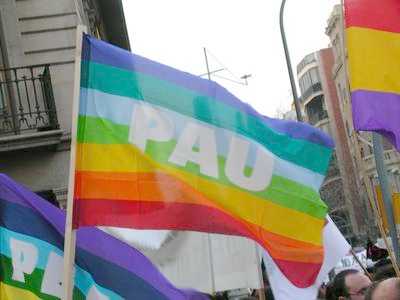 Barcelona, March 20, 2004. Photo from Indymedia Barcelona What a Difference a Day Makes...... By ELLE McKENZIE Here, in Spain, we do not wait long to bury the dead; a day, three at the most. These last few days many in Spain have buried their dead, but on Sunday, three days after the attack of March 11 in Madrid, the electorate buried a government. All were unexpected deaths. The small commuter town of Alcala de Henares, formerly most famous for being the birthplace of that most famous Spaniard, Miguel de Cervantes, is this week a town of burials. Over 40 of the passengers killed last Thursday, March 11, got on the 7.15 train at Alcala on its way down the Guadalajara line into Atocha station in central Madrid. As the town Mayor, Bartolomé González pointed out, "This is the time the people of Alcala go to work in Madrid. If the train has a capacity for 1,500, then 1,100 come from here." Amongst the dead being buried in Alcala this Monday were Francisco and Jorge Fernández; father and son. The father, a trade union official, the son a student, they travelled together every day, one reading the paper, the other studying. According to newspaper reports they were sitting within a few feet of one of the rucksacks containing explosives, a detonator, a mobile phone to activate the bomb and metal screws that would intensify the injuries inflicted. Sitting in the mourning room of the Cementario de Jardin are a wife, a mother, two sisters and a three year old son. The other seven mourning rooms are similarly filled. Yet, in this town so devastated by loss, Mayor González called on the people to react with calm. Before Sunday's election he said, "The best way to protest is with our peaceful votes." It seems the whole of Spain heard him. If , last week, you had asked anyone here about who was going to win the general election on the 14th March, they would all have replied, "Aznar," whatever their political beliefs. You may not have heard of him until just over a year ago when he took the unfortunate step of aligning Spain with Britain and the USA in supporting the invasion of Iraq. His party may be called Partido Popular, but allying Spain with this self-righteous show of might was unpopular with some 90% of the Spanish people. Still, he was certain to win the general election. At the simplest level this is explained by a strong economy and low unemployment figures. Yet, within three days Aznar, his PP party and his successor, Mariano Rajoy, had been buried by the Spanish voters.
Whilst many of us here are delighted to see the Socialist PSOE return to power after eight years of a right-wing government, our delight is overshadowed by the knowledge that this victory was largely gained on the back of a human disaster. If Thursday had not happened, how different would Sunday have been? The bombings triggered a now too familiar sequence of events, and it was these as much as the deaths of 200 people that ultimately led to Zapatero's win. We have witnessed many instances of mass carnage in recent years and know the drill. First the prime minister or the president, issues a statement condemning the perpetrators as 'evil', followed by similar statements from other heads of countries, plus the Pope. Then, as quickly as possible, blame is attributed. José Maria Aznar, without any hesitation named ETA, the Basque separatist group. It wasn't surprising that he did so, given ETA's history of attacks prior to previous elections in Spain. But the scale of the attack in Madrid was beyond anything ETA had attempted before, and in the first hours that followed it, people on the streets here were wondering if it was an Islamic group. Yet, the government seemed not to be wondering at all. Indeed, Foreign Minister, Ana Palacio, instructed all Spain's ambassadors to take the line it was ETA. In the European Parliament this view was accepted. This was despite statements of denial from the Batasuna party, ETA's political wing. It was also despite knowing that ETA has been severely depleted of members recently. Spain's anti-terrorist police squads have arrested so many ETA members over the last year that papers here surmised there must be only a handful of activists remaining. It is also known that these ETA activists are all recent recruits, all aged between 20 and 30, but they are more idealistic and aggressive than their predecessors. So, did they have the manpower, or experience, to organise an attack on this scale? The fact that the explosive used on Thursday was the same as that stolen by ETA from a French quarry last year was taken as sufficient evidence of their involvement. True, this same explosive had been found in a lorry coming into Madrid some months ago, and that was brought in by ETA members. But, brands of explosive are not necessarily exclusive to one group; exchange of goods is fundamental to the paramilitary group marketplace. It was flimsy evidence. However, it was in Aznar's interests for it to be ETA, as part of his election campaign was based on the fact that PSOE was 'soft' on ETA, while PP promised to crack down on them. ETA is, more or less, Spain's equivalent of the IRA and has been operating in Spain since 1959. It wants independence for the Basque region in the north of Spain, which straddles the Pyrenees to take in part of France. Neither Spain or France are likely to give the separatists what they want. If it turned out not to be ETA, then clearly Aznar would have known he had a problem, especially if it was found that the attacks were linked with Al Qaeda. If the bombing in Madrid was a direct result of Spain's support for the Iraq war, Aznar would be held responsible. What followed next in terms of the media message was likely crucial to Sunday's election result. On Thursday evening, an Arab paper based in London put a message out on the wires saying it had received a fax from Al Qaeda claiming responsibility. There was a noticeable reluctance to accept this, the party line broadcast via the state-sponsored news on channel TVE said that they frequently made false claims. A van was found with a tape of Koranic verses and paraphernalia bombers would use. Still, the finger was pointed at ETA. On Friday evening, 11 million people marched through the streets of Spain, displaying their grief and showing their solidarity with the bereaved. On Saturday night it was announced that five men had been arrested in connection with the bombing; three Moroccans and two Indians. A rucksack found in one of the train carriages contained explosives, a mobile phone and a SIM card, the phone being used to detonate the bombs. The SIM card led the police to a Madrid shop and from there to these men. One of the Moroccans, it was later revealed, had been involved in the Casablanca bombing last year. The suspicion that this was retaliation for Iraq was getting stronger in the minds of many. Thousands returned to the streets of Madrid and surrounded the PP headquarters, demanding that the government tell them the truth. Radio station Cadena Ser announced that it had information from a senior intelligence source saying that the intelligence services had told the government that it was an Islamist extremist group. The head of the intelligence services denied the report, as did the Minister for the Interior, Angel Acebes, who was largely responsible for putting out statements to the media. Was there a deliberate smokescreen of misinformation? The people thought so. Then, on Sunday morning, just as the electorate was preparing to vote, a videotape was recovered, following an anonymous tip-off, of a man calling himself Abu Dujan al Afghani, and proclaiming himself military spokesman for Al Qaeda in Europe. He said: "We declare our responsibility for what happened in Madrid exactly two-and-a-half years after New York and Washington. This is an answer to the crimes in Afghanistan and Iraq." Mariano Rajoy, Aznar's appointed successor as party leader, faced shouts of "murderer" as he went to cast his vote later that morning. It became clear as the day went on that Aznar was going to pay the cost for so readily blaming ETA, and for bringing this attack on Spain by supporting the intensely-disliked Bush regime. Of course, perhaps the Spanish electorate should have blamed the Spanish king and queen, Ferdinand and Isabella for financing the Columbus expedition in the first place. In the end, some 70% of the electorate turned out to vote, and they voted from their hearts. By early evening PP conceded the election. Spain had a new government; a socialist one. Unfortunately, PSOE did not win enough seats for an absolute majority. Already, Zapatero has said he will not make a formal alliance with any of the regional parties, for example the Catalonian socialists, saying he will govern by having a dialogue with the other parties. This is making a few people nervous. Does he have the maturity for the job, they are asking? There is some relief that he plans to reinstate Spain's more traditional political alliances with France and Germany. There is much of interest to keep track of here over the next few weeks and months. How will this impact Bush? How will it affect Blair? Might it strengthen a sense of European unity, something desirable that the pessimists say is impossible? Last Thursday, the attack brought not just a new government to Spain, but a multitude of questions for Spain, and for the rest of Europe. Many of these will be about the USA. In Madrid this week, people were searching in a warehouse for the belongings of the injured and the dead. On one table lay dozens of copies of the latest in the series of Harry Potter books, The Order of the Phoenix, released in Spain last month. In legend, the phoenix always arises from the ashes. Now Spain must do the same; the rest of Europe as well. ++ http://www.guardian.co.uk/spain/0,2759,181077,00.html |